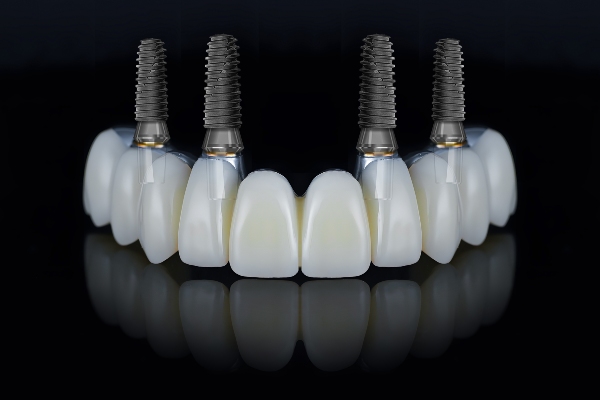
 All-on-4® implants are permanent tooth restorations as opposed to their alternative, removable dentures. Both are wonderful options to restore your smile, whether you are missing all or only a few teeth. However, All-on-4 is only available to a select group– learn the difference between the two options.
All-on-4 explained
All-on-4 is also known as a full-mouth dental implant. That is because the periodontist inserts four to six dental implants on one arch (upper or lower), supporting an entire row of dentures. The dentures attach to the implants, which means they are not removable. While it seems simple enough, a periodontist must ensure each patient is an ideal candidate for this restorative. They will consider the following factors:
- The patient’s has a sufficient amount of healthy bone density
- No presence of gum disease or infection
- The patient is a non-smoker
- All or the majority of teeth are missing
The periodontist will also assess any medication the patient is taking or underlying medical conditions since certain ones can affect the procedure's success. All-on-4 involves a lengthy nine-month process with multiple surgical procedures. The exact number of procedures depends on the individual. It is worth noting that a patient is not automatically declined if they show signs of any of the above.
For example, a bone graft may provide the density needed to insert and hold the implants. Also, if gum disease or an infection is present, the periodontist will provide treatment before re-screening them for All-on-4 later. Nevertheless, the rest of the process will involve inserting the implants (titanium screw) into the jawbone. Following this, the jawbone needs time to fuse with the titanium implant in what is known as osseointegration. Then, we can attach abutments to the implants, creating the appearance of natural, fully functional teeth.
Dentures explained
Dentures, or false teeth, have multiple types and are often the go-to if one is not seen as a candidate for All-on-4. The periodontist will consider the following types of dentures:
- Complete dentures. Custom-made to fit the mouth and simulate a natural smile while needing a bonding agent to secure to the gums, as they are for those missing all their teeth
- Overdentures. Sit on gums but are attached to dental implants (not All-on-4) and are removable
- Partial dentures. They can be fixed or removable and are for those with only a few missing teeth
- Snap-on dentures. For those with dental implants (not All-on-4) that allow partial dentures to snap onto the abutments
It is worth noting that all dentures, no matter the type, must be custom-made. This is to simulate a natural-appearing and functional smile. Each type will come with its own set of instructions for proper care so they can last for many years to come.
Call to us to see which is best for you
All-on-4 and dentures are great options to restore your smile. The choice all depends on your oral state. If you are interested in restoring your smile using either option, contact our office to schedule a consultation.
Request an appointment or call Charles E. Dyer IV, DDS, MS, PC at 281-213-0900 for an appointment in our Cypress office.
Related Posts
All-on-4® dental implants are permanent full-arch restorations. This alternative to dentures restores the teeth without the use of a removable device. Instead, All-on-4 functions like real teeth, providing various benefits beyond simply restoring one's smile. Here are a few pros and cons of All-on-4 implants.Dental implants are screwlike posts that act as replacement tooth roots.…
Curious about All-on-4® dental implants? Read on to learn more. For several decades, traditional dentures were the norm for restoring several missing teeth. With the introduction of dental implants, patients have a more natural-looking, less problematic alternative. All-on-4 dental implants take the benefit a notch higher. Now, it is possible to replace an entire arch…
All-on-4® offers a simpler and more cost-effective solution to tooth loss. This technique replaces a full set of teeth with just four implants, making for an easier process, among other advantages. Here is a quick overview of how All-on-4 is restoring smiles.The All-on-4 system supports a denture that replaces the entire arch of teeth with…